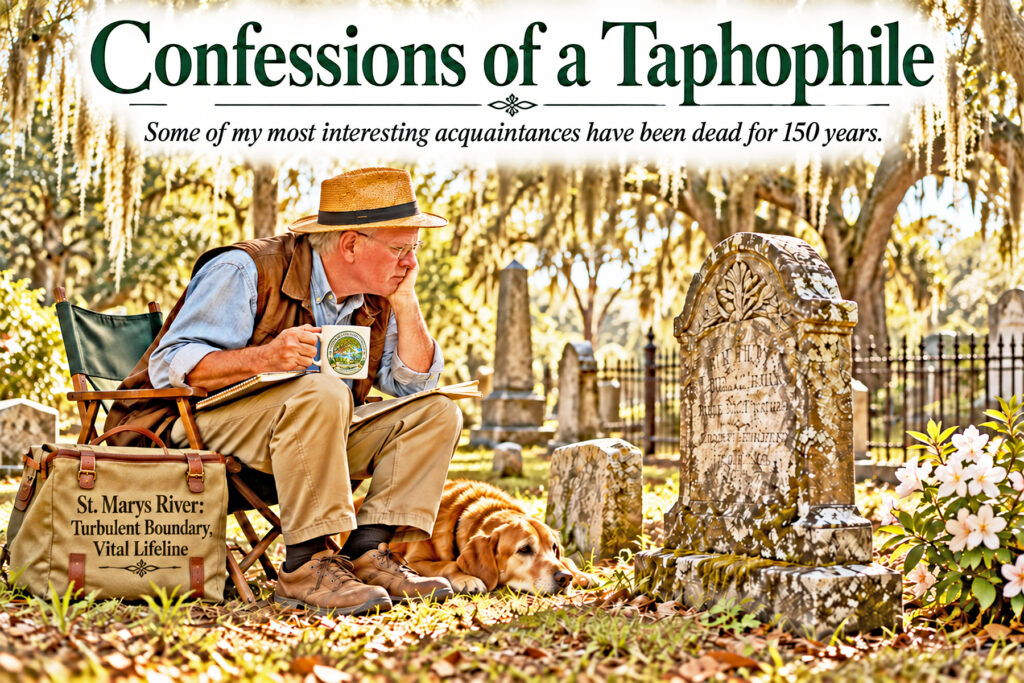
 Confessions of a Taphophile
Some of my most interesting acquaintances have been dead for 150 years.
Looking back, I realize that I’ve experienced taphophilic urges from childhood.
Before you telephone the sheriff, let me explain.
I’ve always been curious about cemeteries, burials, and the people who occupy them. My first funeral was that of my great-grandmother, Julia Victoria Haddock Connors. I knew her. I remembered her. I stood next to her in a family photograph. She made the best baked beans I have ever tasted. She had been a living, breathing person, part of my world. And then, suddenly, she wasn’t.
I struggled to understand that. How could someone be here one day and gone the next? Where had she gone? And how could a life, with all its experiences, memories, laughter, and relationships, be reduced to a name and a couple of dates carved into a gravestone?
As a child, I found that troubling. I also found it fascinating.
The gravestone told me when she was born and when she died. It told me absolutely nothing about the years in between. And those, it seemed to me, were the most interesting parts.
I began looking at other gravestones with much the same curiosity. Who were these people? What had their lives been like? What did they do, whom did they love, and what happened to their stories when the people who remembered them were gone?
Apparently, most children didn’t spend much time worrying about such things. They had baseball cards to collect, bicycles to ride, and considerably livelier people to play with.
I had questions for the dead.
It took me years to discover there was actually a word for people like me.
Taphophile.
Imagine my relief. What I’d feared was a peculiar childhood affliction turned out to be a perfectly respectable historical interest.
Although I’m not entirely convinced my family would agree.
Are You a Taphophile?
You might be a taphophile yourself and not know it.
Have you ever stopped at an old cemetery because a weathered gravestone caught your attention? Wondered about the people buried there, where they came from, what they did for a living, or why an entire family seemed to disappear within a few years?
Have you ever found yourself reading the inscriptions on gravestones belonging to people you never knew, then wondering what their lives were like?
If so, congratulations. You may be one of us.
Common symptoms include an uncontrollable urge to investigate old cemeteries, excitement over discovering an 1850 census record, and an inability to pass a weathered tombstone without wondering who’s beneath it.
The condition is generally harmless, not contagious, and apparently incurable. Symptoms frequently worsen with age.
I’ve discovered that cemeteries offer remarkably pleasant company. The residents seldom interrupt, never argue politics, and rarely complain about the weather. Getting them to answer questions, however, can be frustrating.
Listening to Stilled Voices
My particular fascination is Kings Ferry Historic Cemetery, overlooking the St. Marys River, where some of my relatives and neighbors have been resting considerably longer than I’ve been alive.
The cemetery contains the remains of physicians, farmers, merchants, veterans, mothers, fathers, and children whose lives were woven into the history of a once-thriving river community.
Some have handsome monuments. Others have modest markers. Many have no markers at all.
A recent ground-penetrating radar survey identified 94 previously unmarked graves, reminding us that history doesn’t always announce itself with an engraved marble monument.
Every one of those burials represents a human life. And every life was part of a family, a community, and a larger historical story.
The challenge for a taphophile is discovering those stories without disturbing the residents. Shovels are generally discouraged.
Why Should Anybody Care?
Here’s where this peculiar hobby becomes something more important.
Historic cemeteries are outdoor archives. Their gravestones, burial patterns, and surviving records provide evidence of the people who shaped the communities we inherited.
But preserving history means more than keeping tombstones upright and mowing the grass.
It means protecting authentic evidence of the past.
Family legends are wonderful things, but they have a habit of growing more impressive with each generation. Dates get confused, relationships become tangled, and ordinary ancestors sometimes acquire accomplishments – or even reputations — that would have surprised them considerably.
That’s why historical research matters. Gravestones, census records, deeds, letters, photographs, and contemporary accounts help us separate what we know from what we think we know.
And sometimes the evidence tells us something we’d rather not hear.
Authentic history isn’t necessarily comfortable history. It includes human achievements and failures, generosity and greed, courage and cowardice. Preserving only the flattering parts doesn’t preserve history. It manufactures nostalgia.
The Lessons They Leave Behind
Why does that matter today?
Because history is more than a collection of dates and deceased people.
It helps us understand how communities developed, why people made particular decisions, and what happened because of those decisions.
By examining the past, we begin to recognize patterns in human behavior, the consequences of choices, and the ways yesterday’s events continue to influence our lives.
History cannot tell us precisely what tomorrow will bring. But it can offer something equally valuable: perspective on the challenges we face and the choices we make.
And perhaps that’s the greatest lesson waiting among those weathered gravestones.
The people buried there lived in a world very different from ours. Yet they faced many of the same fundamental challenges. They struggled to make a living, raise families, overcome hardships, find happiness, cope with loss, and build something worthwhile to leave behind. They experienced love and disappointment, success and failure, hope and heartbreak. Sound familiar?
Their circumstances may have been different, but their humanity was much like our own.
Everybody has a story. Some have been forgotten, some misunderstood, and others never told. We owe those who came before us more than a name and two dates carved into stone. We owe them the opportunity, through our efforts, to tell us who they were, how they lived, what they struggled with, and how they met the challenges of their times.
And in recovering their stories, we may discover something unexpected about our own lives: that the distance between yesterday and today isn’t nearly as great as we imagined.
Perhaps that’s why we ought to tell their stories. Not simply to remember the dead, but to better understand the living.
After all, the more we learn about the lives they lived, the better we may come to appreciate the lives we’re living.