News, History, and Reflections
on the Historic St. Marys River
“Most people do not realize what a treasure we have in the St. Marys River.”
— John Hendricks, President, West Nassau Historical Society
The St. Marys River has shaped this region for centuries, and its history—stretching across Georgia and Florida—reveals how borders, conflict, commerce, and community have repeatedly converged along its banks. St. Marys River history is often hidden in plain sight, but over centuries this river has served as a boundary, a highway, and a stage for events that still shape life along its banks today.
Those of you reading this all have something in common: you have crossed the St. Marys River. As you concentrated on the traffic ahead of and beside you, your river experience was a slight bump, a blurry sign that sped by, a brief glimpse out of the corner of your eye of green, tree-covered banks, and blue-brown water. Without giving it much thought, you had just brushed past our treasure, one of the most historically important waterways in the Southeast–and perhaps the least understood.
Most of us cross the St. Marys River without giving it much thought. It is familiar, quiet, and always there—something we pass over on the way to somewhere else. Yet, as John Hendricks reminds us, that familiarity often conceals a deeper truth. The St. Marys River is not merely a scenic boundary or a recreational waterway; it is one of the most historically significant rivers in the Southeast, and perhaps one of the least understood.
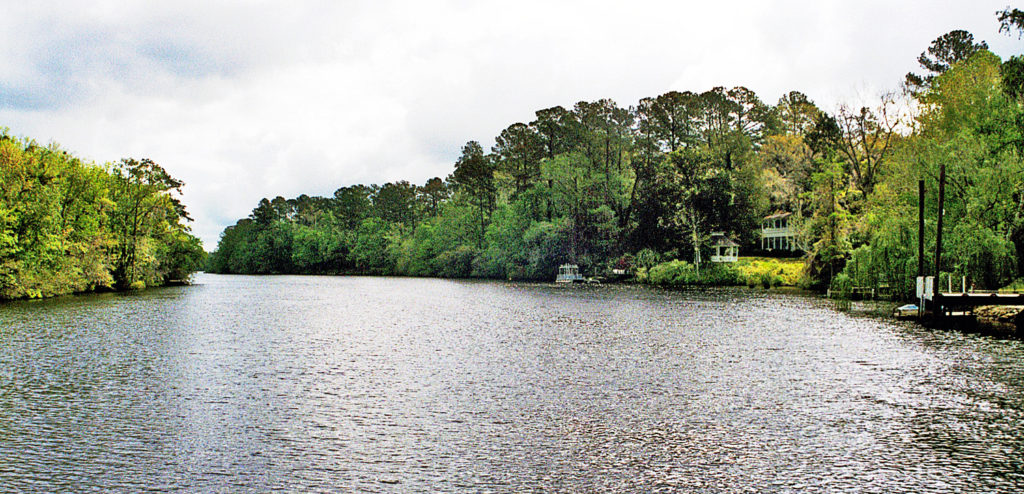
For centuries, the St. Marys has been a corridor of movement and meaning. Long before paved roads or rail lines, it carried Native peoples, traders, soldiers, enslaved men and women seeking freedom, lumbermen, and steamboats. It served as a political boundary between empires and later between states, a commercial highway linking inland forests to distant markets, and at times a front line of conflict. Events that unfolded along its banks shaped not only local communities but occasionally influenced national affairs as well.
And yet, much of that story remains fragmented. We encounter it in place names, family histories, scattered documents, and half-remembered anecdotes—but rarely as a connected whole. Without that larger framework, it is easy to underestimate the river’s role in shaping who we are and how this region came to be.
Soundings & Currents is an effort to bring that story back into focus.
Each month, this column will explore the St. Marys River from two complementary directions. The first is the Soundings—what is happening along the river today. That includes programs sponsored by historical societies, museum lectures, conservation efforts, archaeological discoveries, community events, and initiatives aimed at protecting and understanding the river we share.
The second is the Currents—brief, carefully researched glimpses into the river’s long history. These will range from vanished river towns and early industries to forgotten military episodes and boundary disputes that once made the St. Marys a place of national attention. Some stories will be familiar; others may come as a surprise. Together, they form a chronology that reveals how often the same forces recur over time.
History, after all, is more than a collection of dates. When viewed across generations, it becomes a record of human behavior—how people respond to opportunity and pressure, how prosperity shifts, how unintended consequences unfold, and how memory fades or endures. One aim of this column is to reflect briefly on those patterns, not to moralize, but to better understand what the river’s past can still teach us about the present.
In the months ahead, we’ll explore episodes such as the War of 1812 reaching the upper St. Marys, the rise and decline of river towns like Traders Hill and Kings Ferry, the transformation of the river economy with the coming of railroads, and the modern efforts now underway to protect this remarkably intact watershed. Just as importantly, we’ll keep an eye on what is happening along the river now—because history here is not finished.
The goal for Soundings & Currents is to encourage readers to see the St. Marys River differently: not just as scenery or a line on a map, but as a shared inheritance—one whose story is still unfolding, and whose lessons are still relevant.
Save the Date…
Nassau Art at the Callahan Depot (NACD)
Thu Jan 29–Sat Jan 31, 2026 Callahan Historic Train Depot
Amelia Island Museum of History — Brown Bag Lunch Program
Wed Jan 7, 2026 (12:00–1:00 PM)
Amelia Island Museum of History — 3rd on 3rd
Fri Jan 16, 2026 (6:00–7:00 PM) Monthly public-history program
Cumberland Island Tour Offered daily (Subject to staff availability) Times: 10:00 AM Where: Begins at the Dungeness dock Cost: Free
Mark Your Calendar…
Mardi Gras Festival Saturday before Ash Wednesday St. Marys, Georgia
St. Marys Riverkeeper — 27th Annual St. Marys River Cleanup
April 19 (9:00–11:00 AM) Multiple sites across the watershed
Did you know…
On January 23, 1820, the Savannah Daily Republican reported the arrival in Savannah of three steamboats—Georgia, Dubois, and Altamaha—from Augusta, towing barges carrying nearly 1,000 bales of cotton. Their arrival confirmed that steam-powered river transportation had become a practical and profitable commercial reality. It would soon change the history of the St. Marys River.
(In the next Soundings & Currents, we’ll explore how and why that happened.)
Tracy Connors, PhD is an historian, author, and retired Navy Captain, He is currently completing a comprehensive new history–St. Marys River: Turbulent Boundary, Vital Lifeline of Southern History. Soundings & Currents, connects the river’s deeper history and the lessons we can still learn, with news and reminders of history in the making.